The Seven Wonders of Trypillian Culture: What Happened to the Trypillians?
In 1896, archaeologist Vikentiy Khvoyka unearthed the first traces of a enigmatic Eneolithic (Copper-Stone Age) civilization in the Ukrainian village of Trypillia. Spanning from the 6th down to the 2nd millennium BC, this ancient culture expanded across vast territories—leaving behind advanced agriculture, masterfully painted ceramics, and massive proto-cities.
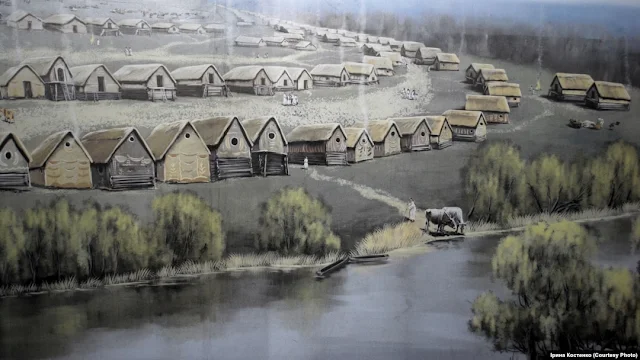
Artistic reconstruction of a prehistoric Trypillian settlement.
Much like how LiDAR technology recently helped uncover a lost Maya metropolis hidden in plain sight, archaeological research in Ukraine continues to reveal the immense scale of ancient urban planning. The "Trypillian Culture" Historical Reserve in Lehedzyste showcases some of humanity's earliest complex societal models.

Full-scale modern reconstruction of two-story Trypillian houses.
7 Astonishing Wonders of the Trypillia Culture
1. Giant Proto-Cities. Six thousand years ago, the earliest mega-settlements appeared in the Cherkasy Oblast region. The Talianky settlement alone covered 450 hectares with 3,000 houses hosting over 15,000 residents. Uniquely, archaeologists have found no administrative buildings, pointing to a highly self-governing and egalitarian society.
2. Advanced Crop Rotation. Trypillians established effective farming sequences thousands of years before formal agricultural science, maintaining crop varieties that persisted in the region well into the Middle Ages.

Ceramic Mother Goddess figurine containing 9 clay pellets inside its belly—producing a rattle sound that echoes 5,800 years later.
3. High-Tech Pottery Kilns. Often termed the "painted pottery culture," Trypillians crafted ceramic masterpieces using large multi-chamber kilns discovered in Dobrovody—predating similar Greek clay-firing technologies by 3,000 years.
Revolutionary Farming & Metallurgical Breakthroughs:
The discovery of ceramic depictions of paired harnesses proves Trypillians utilized wooden plows, boosting farming efficiency 40-fold over hand-hoeing. Furthermore, early metallurgy yielded items like a 6,500-year-old copper fish hook—the oldest metal artifact in Ukraine.
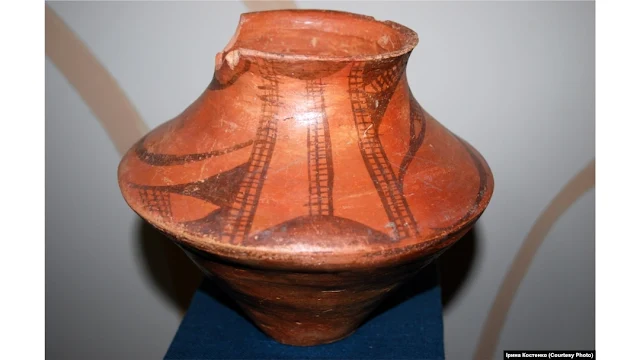
Ceramic vessel depicting the earth, sky, and a connecting ladder, representing the Trypillian worldview.
4. Early Weaving. Clay pot imprints reveal that Trypillians wore loom-woven and crocheted textiles six millennia ago.
5. Eco-Friendly Architecture. Houses were constructed using wooden frames, multi-layered clay plaster, and natural insulation—foundations that closely mirror modern sustainable eco-building techniques.

A 6,500-year-old copper fish hook—a testament to early European metallurgy.
Deep historical studies into European antiquity often reveal unexpected connections, similar to how scientists recently re-examined the mystery of the screaming mummy or traced major dynasties back to the lost tomb of Pharaoh Thutmose II.

Binocular-shaped ceramic vessel, reminiscent of traditional Ukrainian double jugs used centuries later.
Where Did the Trypillians Go?
While debate continues regarding the ultimate fate of this civilization, many scholars link Trypillian heritage directly to early European agricultural development and regional cultural continuity across thousands of years.
What Are Your Thoughts?
Which aspect of Trypillian civilization surprises you the most—their massive proto-cities or their advanced 6,000-year-old technologies? Share your perspective in the comments below!


Comments
Post a Comment