Seven Wonders of the Trypillian Civilization — Where Did They Disappear To?
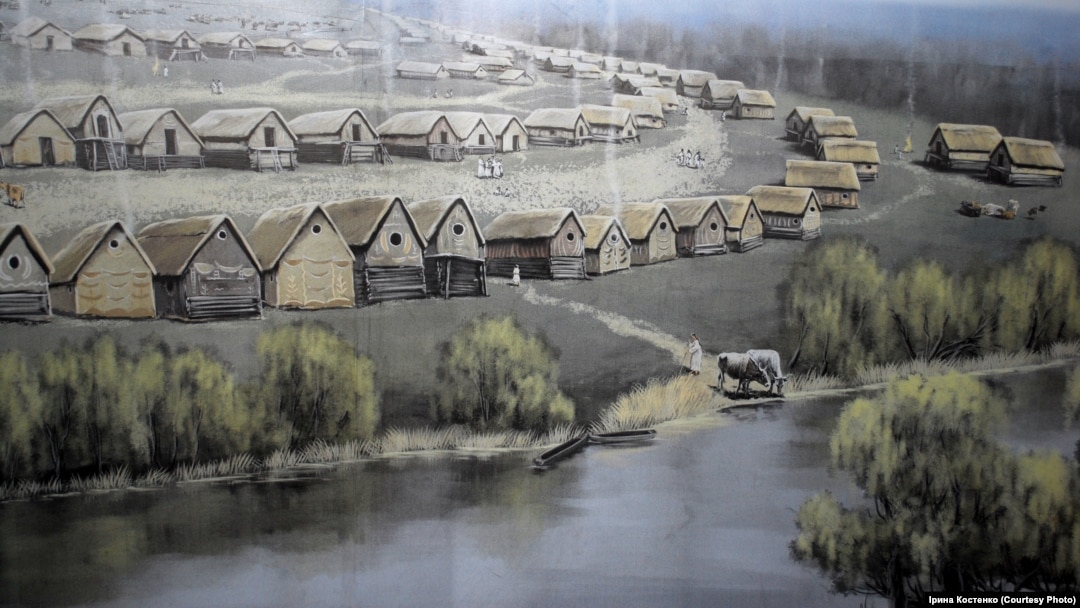 |
| Reconstruction of a Trypillian settlement |
In 1896, Kyiv archaeologist Vikentiy Khvoyka made a sensational discovery. In the village of Trypillia, not far from Kyiv, he unearthed the first finds of a mysterious Eneolithic (Copper-Stone Age) culture. This culture soon came to be known as the "Trypillia culture." From Khvoyka's time until today, this designation has remained unchanged, even though the spatial boundaries of the culture expanded from the Chernihiv region to the Black Sea and the Balkan Peninsula.
Extremely beautiful ceramics, large settlements on riverbanks, and rectangular houses with painted walls became the main defining features of this remarkably rich farming culture, which developed across a vast part of Ukraine's territory starting from the 6th down to the 2nd millennium BC, writes Radio Free Europe / Radio Liberty.
 |
| Modern reconstruction of Trypillian houses |
 |
| Ceramic figurine of the Mother Goddess. It has 9 clay pellets inside its belly; when shaken, you can hear a sound that echoed 5,800 years ago. |
The ancient Trypillian civilization in Ukraine is a unique phenomenon in human history. One can enrich their knowledge on this topic—in detail, engagingly, and through amazing artifacts—at the "Trypillian Culture" Historical and Cultural Reserve in the village of Lehedzyste, Cherkasy Oblast.
We recently visited it, listened to an incredible guided tour by the reserve's director, Vladyslav Chabaniuk, and based on what we learned, decided to compile a list of 7 astonishing wonders of the Trypillia culture.
1. Giant proto-cities. Six thousand years ago, the first large settlements appeared on our planet. And this happened right in the area of Uman, in today's Cherkasy Oblast. One of the largest Trypillian settlements, Talianky, covered an area of 450 hectares and had 3,000 houses inhabited by over 15,000 people. The life of each such proto-city lasted up to 100 years, as the Trypillians were farmers, and periodic relocation was driven by soil exhaustion.
 |
| Reconstruction of a Trypillian settlement |
A distinct feature of Trypillian society was prosperous social equality. Remarkably, among the buildings of their ancient settlements, archaeologists have not found a single administrative building. This may indicate a high level of self-governance among the Trypillians, or put differently, everyone in this society knew exactly who was supposed to do what and how.
“Our archaeologists are slowly beginning to suggest that all these European values regarding equality and democracy should be drawn not from antiquity, but from these Trypillian settlements. Thousands of years ago, models of co-existence for vast communities in one place were worked out right here,” reflects reserve director Vladyslav Chabaniuk.
2. Crop rotation. The modern definition of crop rotation is a scientifically grounded sequence of agricultural crops designed to increase yields.
Six thousand years ago, however, the Trypillians introduced such a farming system without recommendations or scientific rationale, managing their land very effectively. In later times, all subsequent generations benefited from the Trypillians' achievements. As archaeologist and Doctor of History Mykhailo Videyko notes, “up until the era of Yaroslav the Wise, the variety of grains in the fields of the Kyiv region remained the same as in Trypillian times.” It is worth noting that the Trypillian crop rotation system remains at the core of modern agriculture to this day.
3. Pottery kiln (or ceramic firing kiln).
Clay items of diverse shapes, purposes, and ornaments are the primary hallmark of the Trypillia culture, which is also often called the "painted pottery culture."
 |
| Ceramic pot depicting earth, sky, and a ladder between them. This is how Trypillians envisioned the order of the world. |
 |
| Fragment of a ceramic figurine of a long-haired woman |
Trypillian pottery can be broadly divided into two categories: some pieces are rough and simple, while others are made of finely crafted clay with thin walls, well-fired, and crafted to astonishing perfection.
This raises the question: what technologies six thousand years ago could ensure such high quality?
Archaeologists found a sensational answer in 2015 when they excavated a pottery kiln in the village of Dobrovody, Cherkasy Oblast. This massive kiln (covering 6 square meters, with multiple fuel ports) disproved the traditional belief that the Greeks invented the first kilns. Trypillians predated the Greeks in advanced clay-firing technology by three thousand years.
4. Paired harness.
 |
| Ceramic depiction of oxen pulling a sled |
These oxen on display at the "Trypillian Culture" Reserve represent the oldest known depiction of a paired harness in European history. Such an artifact points to significant progress in Trypillian agricultural practices.
“With a paired harness, they were able to use a wooden plow (socha). Plowing with a scratch plow is 40 times more productive than cultivating land with a hoe. Therefore, it is reasonable to suggest that this very Trypillian invention made the creation of their giant proto-cities possible,” explains Vladyslav Chabaniuk.
5. Weaving. Weaving was a major achievement of the Trypillia culture. Thanks to this invention six thousand years ago, Trypillians dressed in a remarkably modern fashion—wearing woven clothing. Their textiles were of two kinds: produced on a loom and crocheted.
 |
| Bottoms of clay pots with imprints of Trypillian fabric |
 |
| Ukraine's oldest metal – copper |
6. Copper. The dawn of metallurgy in our lands also traces back to the Trypillians. They smelted copper to manufacture tools and ornaments. Vladyslav Chabaniuk dreams of creating a proper exhibit for this metal in the museum: “It should be a dark hall where, against a dark backdrop with special lighting, Ukraine's oldest metal—copper—will be displayed.”
Today, the museum's display presents Ukraine's oldest metal through an astonishing artifact: a 6,500-year-old fish hook. The hook remains sharp to this day and could easily catch a fish weighing up to 5 kilograms.
 |
| Copper fish hook aged 6.5 thousand years |
7. Dwellings. Trypillian houses were two-story rectangular structures. The walls were wooden, plastered on both sides with multi-layered clay, and often painted in dark red hues.
 |
| Wall fragment of a Trypillian house with plaster (nearly like modern Venetian plaster), showing that Trypillians were true aesthetes |
The layout and design of Trypillian houses resemble later traditional Ukrainian homes as well as modern eco-houses. Homes built with timber frames, clay plaster, and natural roofing—which stay cool in summer and warm in winter—are in high demand again today. Thus, it appears the foundations of modern eco-building were laid by the Trypillians over six thousand years ago.
 |
| An amazing exhibit – corn gromwell seeds. These are the oldest museum seeds in Europe – over 6,000 years old |
An amazing collection of artifacts and information about the Trypillia culture can be viewed on the online resource of the "Trypillian Culture" State Historical and Cultural Reserve.
Regrettably, despite its official status, the reserve has received no state funding since 1996. However, thanks to grants, donors, and—most importantly—the extraordinary enthusiasm of its director and staff, the museum in Lehedzyste impresses visitors with a unique exhibition of thousand-year-old artifacts, each carrying its own living history.
 |
| Binocular-shaped ceramic vessel, closely resembling traditional Ukrainian double jugs used by peasants a century ago to carry lunch to the fields |
Finally: Where did the Trypillians go?
Science today has no single definitive answer to where the Trypillians went. However, a number of scholars link the Trypillia culture to the Ukrainian people, including historian and rector of the Ukrainian Free University in Munich, Vadym Shcherbakivskyi.
He notes: “There was no migration of Slavs. Slavic Ukrainians have lived in Ukraine since the Neolithic era... We believe that the history of Ukraine begins in the Paleolithic, and that all successive major cultures in Ukraine represent stages in the formation and development of the Ukrainian people up to the present day. Studying history as a whole, combining geographical, economic, and episodic factors, grants a true understanding of the past and points the way forward for the Ukrainian people.”


Hey some Trypillian love! I had a chance to excavate at a similar aged site in Ukraine called Verteba cave. So interesting
ReplyDeleteнеправильно уявляти собі трипільців як задоволених, веселих людей, які знічев’я мандрували територією сучасних Румунії, Молдови й України. Насправді життя у них було досить важке та хаотичне. Життєвий максимум становив 30-35 років. Їм однозначно бракувало їжі, води та землі. Ліків від хвороб не було, велика дитяча смертність компенсувалася ранньою народжуваністю...Трипільський орнамент існував як засіб боротьби людини з хаосом. Тогочасні люди насправді сильно переживали і боялися навколишнього світу, тож цей орнамент, яким ми так захоплюємося, з’явився не для прикраси, а через страх. Людина боялась порожнечі і намагалася заповнити її якимись орнаментальними зображеннями. Ці малюнки – не естетство, не задоволення світом, а навпаки – захист від світу. Цими ритмічними зображеннями знаків на посуді трипільці вносили космос в довколишній хаос”.
ReplyDeleteкліматологи стверджують, що в середині III тисячоліття до н. е., почалася глобальна посуха. Боги перестали давати вологу, а молитви та ритуали не допомагали її повернути. Разом із тим із насиджених місць у степах зірвалися у пошуках нових пасовищ кочівники, які спрямували свої табори на Захід. Давні народи Західної та Центральної Європи теж почали шукати кращого життя, подавшись на Схід. У цьому здвигові народів розчинилася і зникла трипільська цивілізація, залишивши нам загадкові розмальовані черепки і дивні фігурки…
Дякую!
ReplyDeleteТрипільці нікуди не ділись. Ми і є нащадками трипільців.
ReplyDeleteВсе добре і гарно описано , але - " на Україні " мені не сподобалось 🤗
ReplyDeleteБула в Легедзино . Просто дух захоплює. від побаченого . Директор дуже любить ту справу , якою займається . Це відчувається в усьому .
ReplyDeleteА посередині - памятник Леніну)) Жартую.
ReplyDeleteДякую😯
ReplyDeleteЛегедзино ❤️ прекрасне місце. Чудові враження
ReplyDeleteНікуди не поділися. Це є наші пращури.
ReplyDeleteНаукові праці Вікентія Хвойки Трипільської цивілізації довели, що Трипільська культура се українська культура .Завдяки розкопкам Вікентія Хвойки в Україні (з 1893 року) відкрилось, що Україна була заселена з давніх часів і має глибоку та неперервну історію. Житло Трипільської цивілізації дуже нагадує українську сільську хату ХІХ–ХХ століть, посуд і орнамент на рушниках і писанках такий же, як в Трипіллі сім тисяч років тому. ». Трипілля вивчали в університетах Європи і США, американські вчені дослідили рештки чотирьох трипільських жінок знайдених у печері Вертеба на Тернопільщині. Складний ДНК-тест показав, що гени трипільців (аріїв) і сьогодні присутні в крові українців. (відео). okiua.blogspot.com/2021/06/blog-post_65.html?fbclid=IwAR1ora_m-AFqb0y2zjOh_aOclfeN_sTMmbwlsqh3PXrHk58P5HOvgBeoKnI
ReplyDelete